
Begin with a usable campaign brief
A request to “promote the new service” leaves too many decisions undefined. A useful brief names the audience, offer, channel, destination and intended action. Add the product information that may be used and the person who can approve a change to the message.
A digital role can identify missing details and prepare focused questions before drafting. If the audience is unclear, creating five versions of the same vague message does not solve the problem. Keep assumptions visible so the marketing owner can correct the direction early.
Connect every claim to approved material
Give the role access to the current product description, brand guidance and approved campaign assets. A previous advertisement may contain an expired offer; it should not automatically become the source for a new claim. Track which version of the brief and source material supports the draft.
When evidence for a number, testimonial or customer result is missing, leave it out or route the question to the owner. An illustrative example should remain clearly illustrative. The agent’s ability to generate persuasive language does not give it authority to invent product capabilities or customer proof.
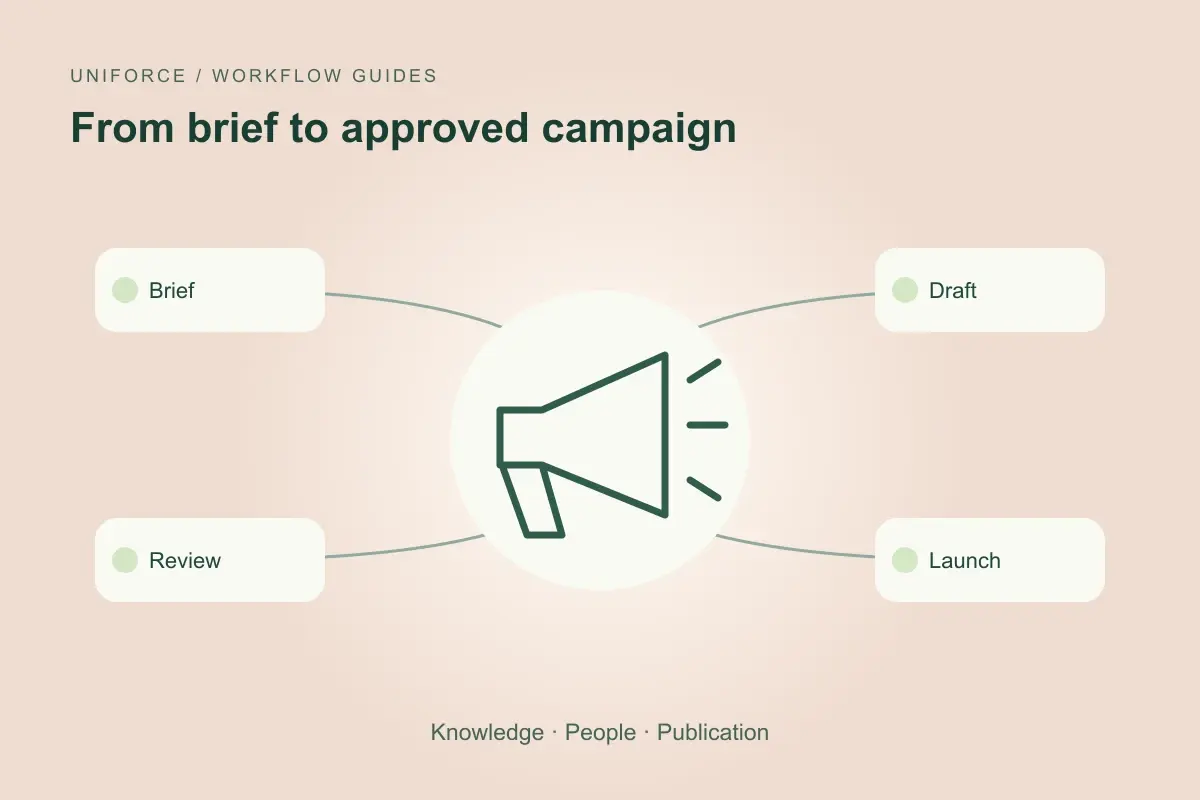
Separate drafting, review and publication
A campaign may need different reviewers for product accuracy, message and final launch. Define the decision each person owns. The review request should include the draft, source references and the specific issue to resolve rather than a generic request to approve everything.
After approval, preserve the approved version. A later edit to price, audience or offer should trigger the appropriate review again. Publishing, changing a live campaign or adjusting spend needs its own permission and confirmation of the connected system’s capabilities.
Carry the message into the sales handoff
A lead generated by a campaign comes with expectations. The receiving sales team should know the offer and next step the prospect saw, without receiving unrelated campaign data. Match the record using agreed identification rules and make the follow-up owner explicit.
Test a changed offer, an unavailable reviewer and a rejected draft before expanding the workflow. Track approval cycles, correction reasons and the quality of the sales handoff. Draft volume alone says little about whether a campaign is useful. Review the work with the people who approve and use it.
Common questions
Can an AI marketing agent publish without review?
Only if the organization explicitly grants that action within a defined scope. A first workflow can stop at an approved draft or scheduled review.
What if product information changes after approval?
Flag affected assets and route them for renewed review. Keep source versions attached so the team can identify which claims depend on the changed information.
How should results be measured?
Track usable approved assets, revision reasons, time spent reviewing and handoff quality. Use campaign performance data with its context rather than attributing every change to the agent.
About this guide
Prepared by the Uniforce editorial team. Examples illustrate proposed workflows, not customer results. The role’s access, actions and review requirements depend on the configured implementation.